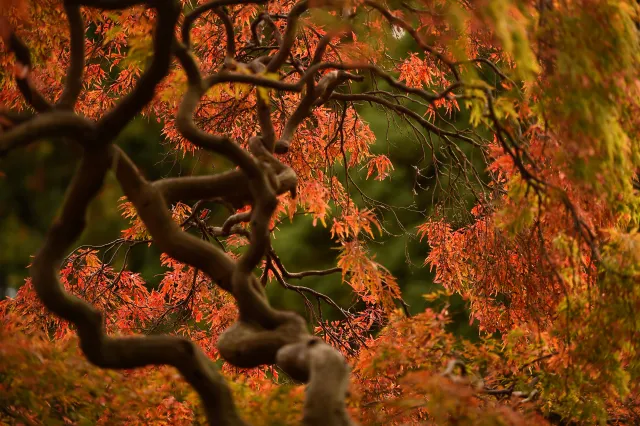
As green chlorophyll breaks down, other pigments become easier to see. The timing and intensity of the display depend on the tree and its environment.
The green of a leaf comes largely from chlorophyll, which plays a central role in photosynthesis. As deciduous trees prepare for winter, changes in the leaf reveal colours that were previously less visible.
Yellow and orange pigments can become apparent as chlorophyll breaks down. Red colours involve another group of pigments, anthocyanins, whose production varies between species and conditions.
A process with several influences
Shorter days provide an important seasonal signal, while temperature and water availability influence how the transition unfolds. A tree under stress may not follow the same pattern as a healthy tree in a different location.
Even neighbouring trees can change at different times. Species, age, exposure and the condition of the roots all contribute. The visual effect across a landscape is the combination of many individual responses.
More than a calendar date
A photograph captures one point in that process. It cannot by itself establish a trend in the timing of autumn. That requires observations collected consistently over many seasons.
The seasonal display is familiar, but its details connect plant chemistry with the weather a tree has experienced. The colours are not simply painted over the green; they emerge as the leaf’s activity changes.